Tamarack (American Larch)
Larix laricina | Zones 1-5 | Soil: Moist, Well-Drained
$25 = 4'-5' in 2 Gal Pot
$20 = 3'-4' in 2 Gal Pot
$15 = 2'-3' in 2 Gal Pot
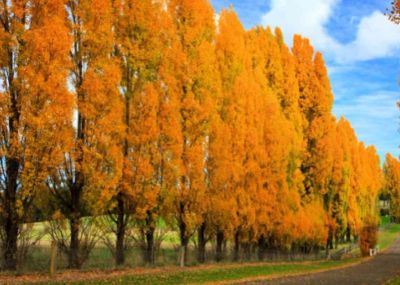
As one of my personal favorite trees, it saddens me to only have this 1 variety of Tamarack at the nursery and put it at the end of the list. American Larch is a Wisconsin native deciduous conifer. Unlike most evergreens and conifers, the Tamarack tree loses its needles each winter season. The soft, bright blue-green foliage turns a rich golden-yellow in fall. A great choice for wet sites!
Mature Height = 60'-80'
Mature Width = 15'-30'

Quaking Aspen (Popple)
Populus tremuloides | Zones 1-7 | Soil: Widely Adaptable
$25 = 4'-5' in 2 Gal Pot
$20 = 3'-4' in 2 Gal Pot
$15 = 2'-3' in 2 Gal Pot
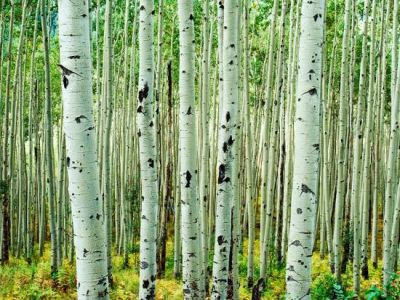
If you enjoy fall walks thru Parnell Tower area, you will know what groves of these trees look like. Known for climate and soil adaptability, with gains of up to 5 feet per year, the Quaking Aspen Tree makes a statement. Especially since it boasts gorgeous fall color you'll love. And the Quaking Aspen is well-known for thriving in cold climates and poor soil.
Mature Height = 40'-50'
Mature Width = 20'-30'

Hybrid Poplar
Populus | Zones 2-9 | Soil: Widely Adaptable
$30= 6'-8' in 3 Gal Pot
$18= 4'-6' in 3 Gal Pot
Hybrid poplars are the thoroughbreds of the tree world. Their claim to fame is speed, with vertical growth of 5'–8' per year not being uncommon. This cotton-less hybrid can be harvested for firewood in five to seven years, making it a sustainable source. It also works well for visual screens and hillside or sand dune stabilization. While nice for quick shade, the hybrid poplar should only be planted in landscape where occasional limb breakage is not a problem.
Mature Height = 40'-50'
Mature Width = 10'-20'
Mountain Ash (Rowan)
Sorbus americana | Zones 3-5 | Soil: Widely Adaptable
$25 = 4'-6' in 2 Gal Pot
$20 = 3'-4' in 2 Gal Pot
This small native tree's dark green leaves turn yellow, orange and reddish-purple in the fall. Showy white spring flowers are followed by large clusters of flame-red, berry-like fruit loved by birds. Likes acidic soil with good drainage, full sun to light shade. Grows to 20'–30'.
This is NOT a true ash (it’s a member of the rose family), so it’s immune to the Emerald Ash Borer.
Mature Height = 20'-30'
Mature Width = 10'-25'

Linden (American Basswood)
Tilia americana | Zones 3-8 | Soil: Widely Adaptable
$18 = 2'-3' in 2 Gal Pot
American basswood is native to the Chicago area and is often used as a specimen or dense shade tree. Its heart-shaped leaves and fragrant flowers in June make it especially attractive for people, while songbirds and blue jays are attracted to its seeds and use the tree for shelter.
Mature Height = 50'-80'
Mature Width = 30'-50'

Linden (Little Leaf)
Tilia cordata | Zones 3-7 | Soil: Moist, Well-Drained
$18 = 2'-3' in 2 Gal Pot
The Littleleaf Linden is a medium-sized broadleaf deciduous tree. Many consider it to be the best of all the Lindens. The tree has a medium growth rate. It does not tolerate wet conditions, severe drought, pollution, or salt spray. It can tolerate heavy pruning and is alkaline soil tolerant. Flowers bloom from June to early July, and their rich nectar attracts bees, butterflies, and hummingbirds.
Mature Height = 40'-60'
Mature Width = 20'-40'

Chinese Chestnut
Castanea mollissima | Zones 4-8 | Soil: Moist, Well-Drained, Sandy, Loamy
$25 = 4'-5' in 2 Gal Pot
$20 = 3'-4' in 2 Gal Pot
As the American chestnut struggles with disease, the blight-resistant Chinese chestnut is quickly gaining popularity. The sweet-tasting nuts are often roasted for holiday eating and have been made famous in turkey stuffing recipes across the country.
But this is more than a nut tree. The shade of its spreading canopy is dense, providing relief in the hot, dry climates the Chinese chestnut does well in.
Mature Height = 40'-60'
Mature Width = 40'-60'

American Hazelnut (Filbert)
Corylus americana | Zones 4-9 | Soil: Widely Adaptable
$18 = 2'-3' in 2 Gal Pot
The American Filbert is a multi-stemmed shrub with a rounded top and an open, often wide-spreading base. Because of its size, it is adapts well to naturalizing and other nonformal areas. It bears annual, abundant crops of small, sweet tasting nuts. It will bear in 2-3 years after planting. The nuts are easy to crack and drop free of the husk when mature. (Plant multiple trees with the same flowering time to ensure pollination)
Mature Height = 15'-20'
Mature Width = 10'-12'

Red Osier Dogwood
Cornus sericea | Zones 2-8 | Soil: Widely Adaptable
$18 = 3'-5' in 2 Gal Pot
The Red Osier dogwood is loved by gardeners, landscapers, and homeowners for its hardiness and versatility. It can grow in a myriad of conditions, including wet soil. Its thicket-forming habit makes it a great hedge option. And the fibrous root system provides effective erosion control on banks and slopes. The biggest selling point, though, is the shrub’s deep red stems. This vibrant hue remains through winter, creating a pop of color in the snowy, gray months.
Mature Height = 7'-10'
Mature Width = 5'-10'
Hedge Spacing = 2' in rows

Eastern Red Cedar (Juniper)
Juniperus virginiana | Zones 2-9 | Soil: Widely Adaptable
$20 = 2'-3' in 2 Gal Pot (SOLD OUT)
$15 = 1'-2' in 2 Gal Pot
These cold-hardy, adaptable evergreen trees serve many purposes in the landscape, especially in sites that are dry, alkaline or windy. The foliage of scale-like needles is attractive but prickly. In late summer and fall, many junipers have blue-green berry-like fruits, actually modified cones, that attract birds. Because they are quite salt-tolerant, they can be used near roads, driveways, and sidewalks.
Mature Height = 40'-50'
Mature Width = 10'-20'
Bald Cypress
Taxodium distichum | Zones 4-10 | Soil: Widely Adaptable
$20 = 3'-4' in 2 Gal Pot (SOLD OUT)
$18 = 2'-3' in 2 Gal Pot
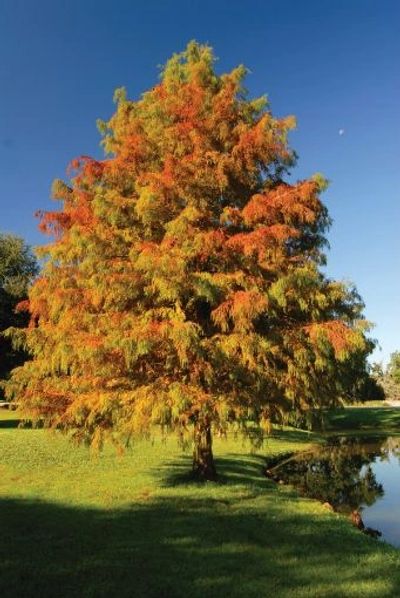
This stately tree, native to the Midwest, is often found in groupings in parks and larger spaces,
along streets, and around lakes. Unlike most cone-bearing trees, bald-cypress loses its needles
each winter and grows a new set in spring. The russet-red fall color of its lacy needles is one of its outstanding characteristics. Hardy and tough, this tree will adapt to a wide range of soil types,
whether wet, dry, or swampy.
Mature Height = 50'-70'
Mature Width = 25'-45'
Lombardy Poplar
Populus nigra | Zones 3-9 | Soil: Widely Adaptable
$30 = 6'-8' in 3 Gal Pot (SOLD OUT)
$20 = 4'-6' in 3 Gal Pot
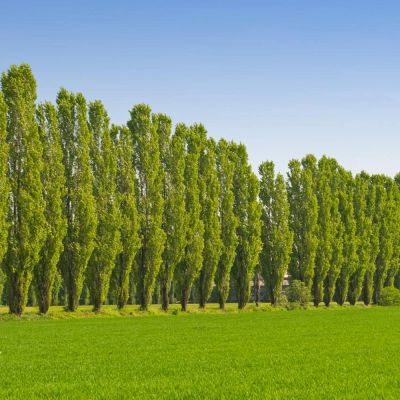
Nothing stops the wind faster. Lombardy Poplars commonly grow 6 feet per year, with some
reaching growth rates of 9 to 12 feet. You often see Lombardy’s planted around farm fields to
keep topsoil from blowing away - and they’ll work just as effectively for your home.
Mature Height = 40'-60'
Mature Width = 10'-15'
Northern Catalpa
Catalpa speciosa | Zones 4-8 | Soil: Widely Adaptable
$25 = 4'-5' in 3 Gal Pot (SOLD OUT)
$20 = 3'-4' in 3 Gal Pot
Catalpa is a Midwest native tree that grows 40 to 60 feet tall, with a narrow, open, irregularly
rounded crown and spreading branches. It has large, heart-shaped leaves and large clusters of
fragrant, white flowers. The long, interesting seed pods persist through the winter. Northern
catalpa is very adaptable to adverse conditions but has weak wood and branch structure.
Mature Height = 40'-60'
Mature Width = 20'-40'
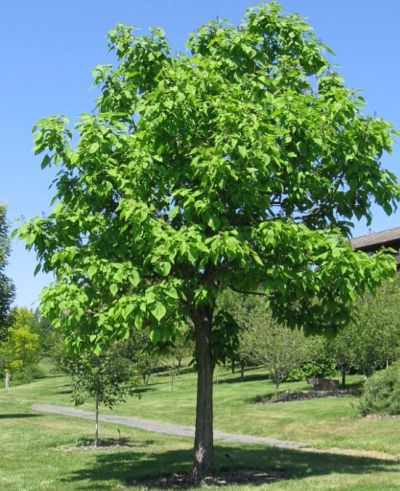
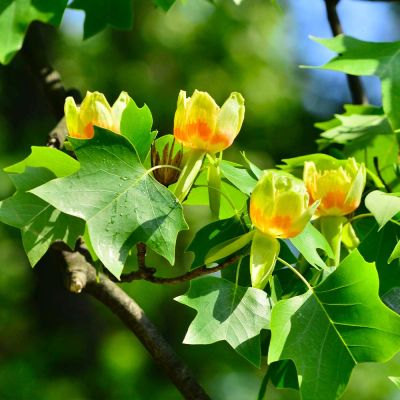
Tulip Poplar (Tuliptree)
Liriodendron tulipifera | Zones 4-9 | Soil: Widely Adaptable
$20 = 3'-4' in 2 Gal Pot (SOLD OUT)
$18 = 2'-3' in 2 Gal Pot
Not really a Poplar. The tulip tree is one of the largest native trees in North America. It is a
member of the Magnolia family. A very fast grower. Beautiful golden-yellow in fall.
Mature Height = 70'-90'
Mature Width = 30'-40'
Bigtooth Aspen
Populus grandidentata | Zones 3-6 | Soil: No clay
$18 = 3'-4' in 2 Gal Pot (SOLD OUT)
$15 = 2'-3' in 2 Gal Pot
The Bigtooth Aspen (Populus grandidentata) is a fast-growing deciduous tree native to eastern
North America. It’s easily identified by its large, sharply toothed leaves that tremble in the wind
and its smooth, pale bark. Common in disturbed areas, it spreads quickly by root suckers and
serves as an important pioneer species. It provides food and habitat for wildlife and adds bright
yellow color to the fall landscape.
Mature Height = 60'-80'
Mature Width = 20'-30'